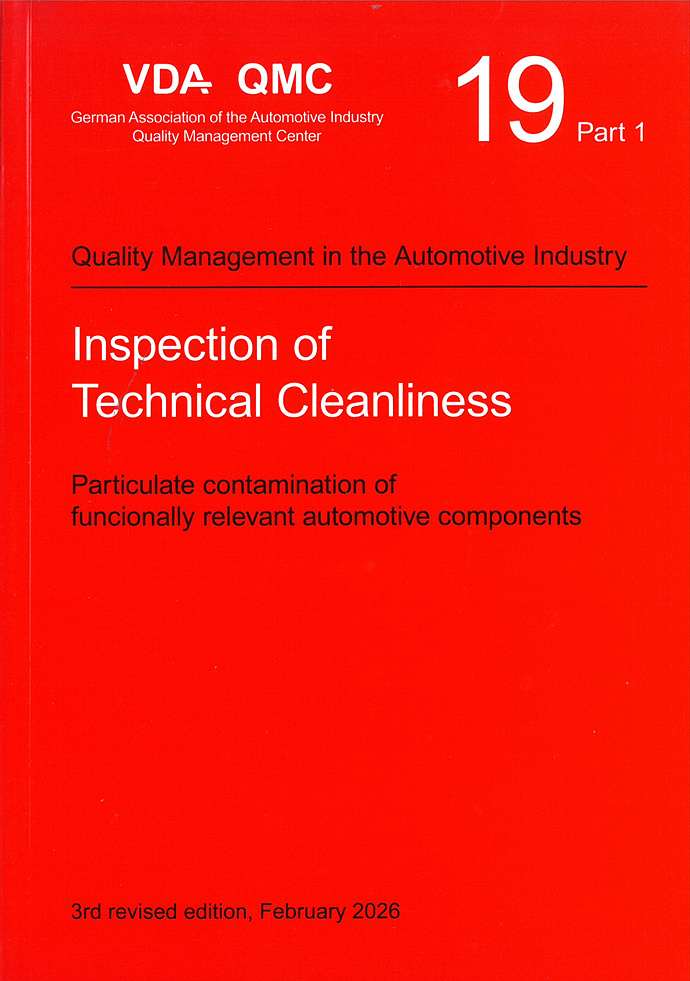
VDA 19.1:2026 - Zkoušení technické čistoty
| Název: | VDA 19.1 - Inspection of Technical Cleanliness >Particulate Contamination of Functionally Relevant Automotive Components |
| Počet stran: | 408 |
| Vydáno: | 2026/02 |
| ISBN: | 978-80-02-02661-1 |
| Verze: | 3. vydání |
| Označení normy: | VDA 19.1:2026 - Zkoušení technické čistoty |
VDA 19.1:2026 - Zkoušení technické čistoty
3. přepracované vydání 2026 (české zatím není vydáno)
Since the first edition of VDA Volume 19 was published in 2004, technical cleanliness has become a key quality characteristic in the automotive industry, which has necessitated the establishment of a number of laboratories and new role profiles, as well as several revisions of the guideline. With the introduction of VDA 19.1 (Analysis) and VDA 19.2 (Assembly), this topic has been further explored and standardized across the industry.
Due to continuous technological progress, the widespread application of the guidelines and the experience gained, a comprehensive revision of VDA Volume 19.1 has finally become necessary.
The main objectives of the revision (February 2023 to May 2025) were:
– Incorporation of new dry extraction methods and new analytical techniques
– Maintaining easily comparable standard analyses while enabling the development of problem-specific, custom tests within defined requirements
– More precise description of particle testing < 50 µm
– Development of standard SEM/EDX analysis with uniform material classes
– Numerous optimizations and improvements in test procedure development and adjustment of initial parameters based on many years of experience in purity testing laboratories
The basic methods and procedures for testing component purity, which were already included in the first and second editions, have proven to be highly effective and have been fully retained in the revision in a more precise and expanded form.
Thanks to the expansion and clarification of the revised third edition of VDA 19.1, this set of rules can not only be used for the design, execution and documentation of cleanliness tests in the laboratory, but is also suitable for other fields such as quality assurance, design and development or supplier management as a quick introduction to the topic.